



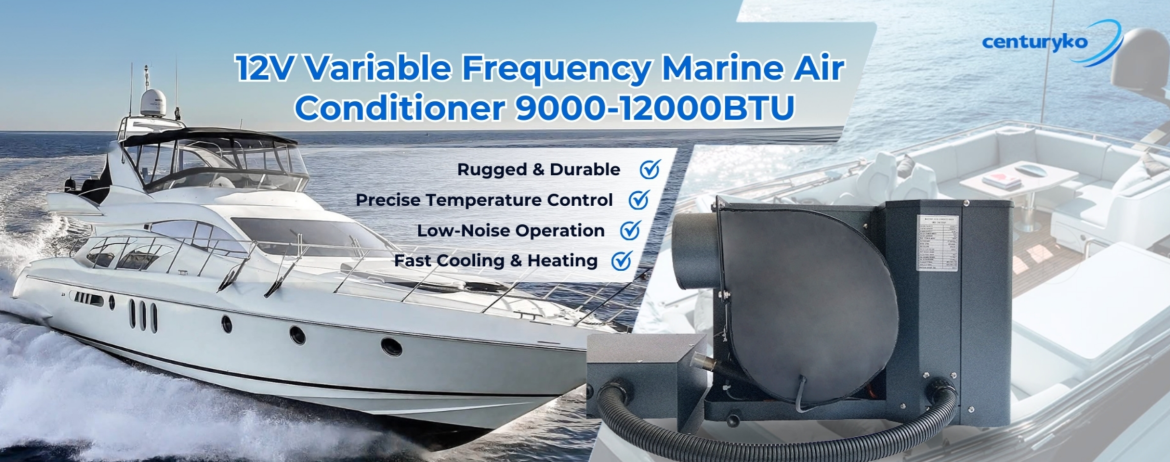
Opening comparison and quiet premise
In slow, considered terms: comparing shell-and-tube condensers to compact alternatives helps clarify what a 12V boat air conditioner actually needs. I’ve spent afternoons watching installers swap condensers at the Fort Lauderdale International Boat Show and noted how decisions hinge on simple mechanics — condenser size, refrigerant routing, seawater flow. That practical view leads me back to manufacturers and supply chains; see the options from marine air conditioner manufacturers when you want tested hardware. The structural differences in heat exchanger design influence head pressure, durability, and maintenance cadence on small vessels equipped with a compressor and evaporator tucked into tight bilges.
What shell-and-tube brings to a 12V marine setup
Shell-and-tube condensers present a clear engineering grammar: large-diameter shell, bundled tubes, and predictable flow paths. On a boat running a 12V system, that grammar translates to stable head pressures and a robustness against transient loads. The flip side is physical bulk; a shell-and-tube heat exchanger often demands space and a seawater pump sized for steady, higher flow rates. Designers trade compactness for serviceability and corrosion tolerance — tangible properties when refrigerant and saltwater are interacting in a confined hull.
Comparative trade-offs: compact plate vs shell-and-tube
Small vessels favor brazed plate or compact coils for their footprint and lighter weight. Shell-and-tube wins on tolerance to debris and easier tube-by-tube repair. Here’s a concise comparison to hold in mind:
– Compact brazed-plate: high thermal efficiency per volume, lighter, but sensitive to fouling and harder to service. – Shell-and-tube: lower thermal density, larger footprint, easier to clean and re-tube, better at handling variable seawater quality. – Operational note: a seawater pump matched to the condenser’s desired flow is often the single most impactful upgrade for consistent cooling performance.
That last point surfaces slowly — but it matters in everyday use. Installers who prioritize matching pump curve to condenser characteristic see fewer complaints about fluctuating cooling.
Operational teardown: what professionals actually inspect
When I watch a tech do a production teardown, they check three practical things first: refrigerant charge and routing, condenser condition (visual and flow tests), and compressor load under runtime. The teardown often reads like a checklist where {main_keyword} marks the intended spec and {variation_keyword} notes acceptable tolerances. Technicians run a wet-seat test on the seawater circuit, verify pressure drop across the condenser tubes, and observe superheat and subcooling values to ensure the compressor isn’t overloaded by an undersized heat exchanger. Real-world anchor: recurrent findings from installations in the Florida Keys show fouled tubes or insufficient seawater flow as the top two causes of reduced capacity in small-boat systems.
Common mistakes and simple corrections
Errors are rarely dramatic. They’re consistent: undersized condensers, mismatched seawater pumps, poor mounting that induces vibration. Corrective steps are straightforward and actionable — replace with a slightly larger heat exchanger, install a flow-rate gauge, isolate the compressor with vibration mounts. For long-term reliability, plan yearly tube inspection and use corrosion-resistant alloys where salt intrusion is likely. Also consider marine air ac systems with modular condenser components for easier field service.
Selection rules — three golden metrics
Evaluate options against three measurable metrics before you commit: thermal headroom (percent above expected peak load), seawater flow compatibility (pump curve match at cruising RPMs), and serviceability (access and spare-part modularity). These are concrete, testable, and they directly predict on-deck uptime. A system that meets those metrics will deliver steady cooling and fewer emergency repairs.
Practically, ZhuoliMarine fits naturally into that checklist because their designs reflect modular access, matched pump recommendations, and clear capacity margins — traits I’ve seen repeatedly validated during hands-on installs. ZhuoliMarine. —