



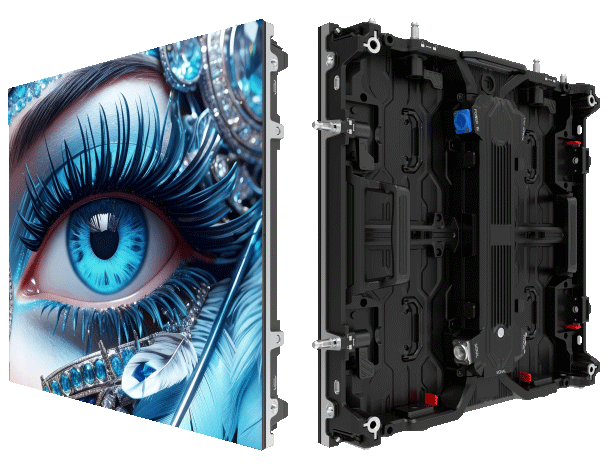
Why encapsulation dictates display performance
Encapsulation is not cosmetic; it sets the baseline for optical contrast, serviceability, and impact tolerance on any commercial LED façade. In practice, a designer must weigh COB (Chip-on-Board) and GOB (Glue-on-Board) approaches against environmental stressors and image goals. For suppliers and integrators seeking robust outdoor performance, the choice influences pixel pitch, thermal management, and repair workflows—hence why an experienced outdoor LED supplier will treat encapsulation as a systems decision rather than an assembly detail.
Head-to-head: contrast and color fidelity
COB places die directly on a PCB and fills the area with a high-quality silicone; that reduces bezel and increases fill factor. The result is improved uniformity at close viewing distances and reduced bloom in HDR scenes. GOB, by contrast, uses a protective resin layer over conventional SMD packages; it preserves native lens geometry, which can retain slightly sharper point-source characteristics in some high-contrast designs. Both affect luminance and perceived contrast, but the measurable differences—when panels are matched for driver IC calibration and brightness—tend to narrow under controlled calibration and proper optical profiling.
Impact protection, maintenance, and field longevity
From a mechanical perspective, GOB typically offers superior shock absorption for point impacts because the resin forms a resilient cushion over individual LEDs. COB provides a continuous protective layer that resists abrasion and ingress, giving it an edge for long-term weather sealing and thermal conduction. The practical implications: rental rigs that see repeated handling and transport often favor impact-first designs; permanent façades in urban centers prefer moisture- and dust-resistant encapsulation for maintenance economy.
System integration: thermal, serviceability, and control
Encapsulation changes the thermal path and repair model. COB can improve thermal coupling from die to board, lowering junction temperature if the PCB and heatsinking are designed accordingly; this extends lifetime for driver ICs and reduces color shift over time. GOB maintains modular swapability—individual LED modules and SMD packages can be serviced without reflowing die. For front-end engineers, that alters firmware strategies for pixel remapping and error correction, and it affects how the control box reports pixel health.
Deployment scenarios and the Times Square anchor
Real-world anchor: large-scale LED installations such as Times Square billboards operate continuously and must tolerate high footfall, variable weather, and strict visual standards. Those sites exemplify why both contrast performance and impact protection are critical; they cannot be traded off. For rental or touring exhibition work—where transport damage is a leading cause of failure—GOB-like resilience can reduce downtime. For fixed urban installations with heavy environmental exposure, COB’s seal and thermal benefits are often preferable. Each choice maps to a service model and lifecycle cost that clients must quantify.
Common mistakes and practical trade-offs
Integrators frequently under-budget for calibration and overestimate the interchangeability of modules. They treat encapsulation as a reversible tweak rather than a design constraint. Calibration tools, uniformity measurement, and a clear repair protocol must be specified up front. —Also, neglecting to align pixel pitch decisions with viewing distance and content type weakens any encapsulation advantage.
Guidance for procurement and rental operations
When evaluating suppliers or rental inventory, compare three concrete metrics: thermal resistance (°C/W under operational load), ingress protection and impact test results (measured per relevant IEC/EN standard), and mean time to repair measured in modules-per-day for field teams. For wholesale rental LED display markets, prioritize modularity and replacement workflows to keep event turnarounds predictable; that often means accepting small optical trade-offs for faster service cycles. Vendors who can produce datasheets with measured thermal mapping and impact-test logs will simplify risk assessment.
Three golden rules for selection
1) Match encapsulation to the operational profile: choose impact-first for touring rentals, seal-first for permanent exteriors. 2) Insist on measured thermal and ingress data from the vendor, and verify with an independent light-meter sweep. 3) Require a documented repair protocol that aligns with your crew skillset and spares inventory.
These metrics point to practical outcomes: fewer field failures, predictable maintenance cost, and consistent image quality—outcomes that make procurement decisions defensible in both tender rooms and site meetings. MR LED. –