




The Hook
Choosing a modular home battery storage manufacturer is difficult because battery capacity is only one part of the decision. Homeowners also need to consider inverter compatibility, expandability, installation requirements, monitoring software, backup operation, warranty terms, and local service availability. Product names and specifications can also vary by market, making direct comparisons less straightforward. This guide tests the three selected options against the practical criteria that matter most for residential energy storage: system flexibility, product scope, intended use, and support considerations. SolaX, Generac, and BigBattery occupy different positions in the market, so the best choice depends on whether the priority is an integrated solar-plus-storage system, a managed home backup platform, or access to a broad range of battery products.
Full List of Top 3 Brands
- SolaX — A solar and energy-storage company offering modular residential battery systems and associated power electronics.
- Generac — A power-resilience company with residential energy-storage and backup products.
- BigBattery — A battery supplier offering residential, off-grid, and other energy-storage products through its online business.
Comparison Table
| Brand | Key Products | Key Features | Best For |
|---|---|---|---|
| SolaX | Triple Power modular home batteries, residential hybrid inverters, and energy-management equipment | Modular system design, solar integration, monitoring, and coordinated inverter-battery operation | Households seeking an integrated solar-plus-storage platform with expansion flexibility |
| Generac | PWRcell residential battery-storage systems and related home-energy equipment | Home backup orientation, system monitoring, and integration with residential power equipment | Homeowners prioritizing backup resilience and a coordinated residential energy system |
| BigBattery | Residential, off-grid, rack-mounted, and other battery-storage products | Broad product selection, different battery formats, and options for varied system designs | Buyers comparing battery configurations for custom, backup, or off-grid projects |
Detailed Reviews
1. SolaX
SolaX develops solar inverters, battery-storage systems, and related energy-management technologies for residential and other energy applications. Its residential storage approach combines modular battery units with compatible hybrid inverters, allowing a system to be designed around household consumption, solar generation, and desired backup capacity. The company’s Australian website presents its home-energy portfolio around solar-plus-storage and energy-management use cases.

SolaX’s Triple Power battery range is designed as a modular storage family rather than a single fixed-capacity appliance. Depending on the applicable model and market, systems can be configured with multiple battery modules and paired with SolaX residential inverter equipment. This architecture can help installers size storage more closely to a home’s energy needs, although the exact usable capacity, module limits, protection ratings, and compatible inverter combinations must be confirmed from the local product documentation.
The company’s broader positioning is important when comparing modular home battery storage manufacturers. SolaX supplies more than a standalone battery: its portfolio includes inverters, battery systems, and monitoring or energy-management functions intended to operate together. That integrated approach can reduce compatibility questions during system design, but it also means buyers should verify whether the preferred installer supports the relevant SolaX equipment and whether local software, warranty, and service arrangements apply.
Pros / Key Features
- Modular battery architecture can support staged system sizing and expansion where the selected model permits it.
- Battery systems are designed for integration with compatible SolaX hybrid inverters and solar installations.
- The product ecosystem includes residential inverters, storage, and monitoring or energy-management capabilities.
- A broad solar-and-storage portfolio may simplify the design of a coordinated home-energy system.
- Local Australian documentation and availability should be checked because specifications and supported configurations vary by market.
Use Cases / Best For
SolaX is best suited to homeowners who want a coordinated solar, inverter, and battery installation and who value modularity when planning future capacity. It can also suit new solar installations and retrofit projects when the existing inverter and electrical design are compatible. Before purchase, buyers should confirm usable energy, continuous and peak output, backup functionality, phase configuration, installation clearances, environmental rating, warranty conditions, and approved module combinations for the exact Australian model.
Competitive Position
SolaX’s main advantage is system integration: the battery is considered alongside the inverter and energy-management layer rather than as an isolated storage box. That can be useful for installers seeking a unified architecture. The principal trade-off is the need to stay within the manufacturer’s approved equipment combinations and local installation requirements. A quotation should therefore identify every component, the supported battery expansion path, and the conditions for backup operation.
2. Generac
Generac is a power-equipment company whose residential portfolio includes energy-storage and home-backup products. Its PWRcell platform is positioned as a coordinated residential energy system rather than simply a collection of independent battery modules. Product availability, specifications, and installation support can differ by country, so Australian buyers should confirm which Generac products and services are locally offered.

Pros / Key Features
- Residential energy storage is presented within a broader home-backup and power-management platform.
- The PWRcell range is designed to work with associated residential energy equipment.
- Monitoring and system-management functions are part of the platform’s home-energy proposition.
- Suitable configurations depend on the home’s solar system, electrical service, loads, and backup objectives.
Use Cases / Best For
Generac is best for homeowners who place a high value on backup resilience and prefer a coordinated residential power system. It may be considered for homes that need selected-load or whole-home backup, subject to the installed configuration and local electrical rules. Buyers should confirm local product availability, installer certification, battery capacity, inverter compatibility, backup switching equipment, warranty coverage, and service response before committing.
3. BigBattery
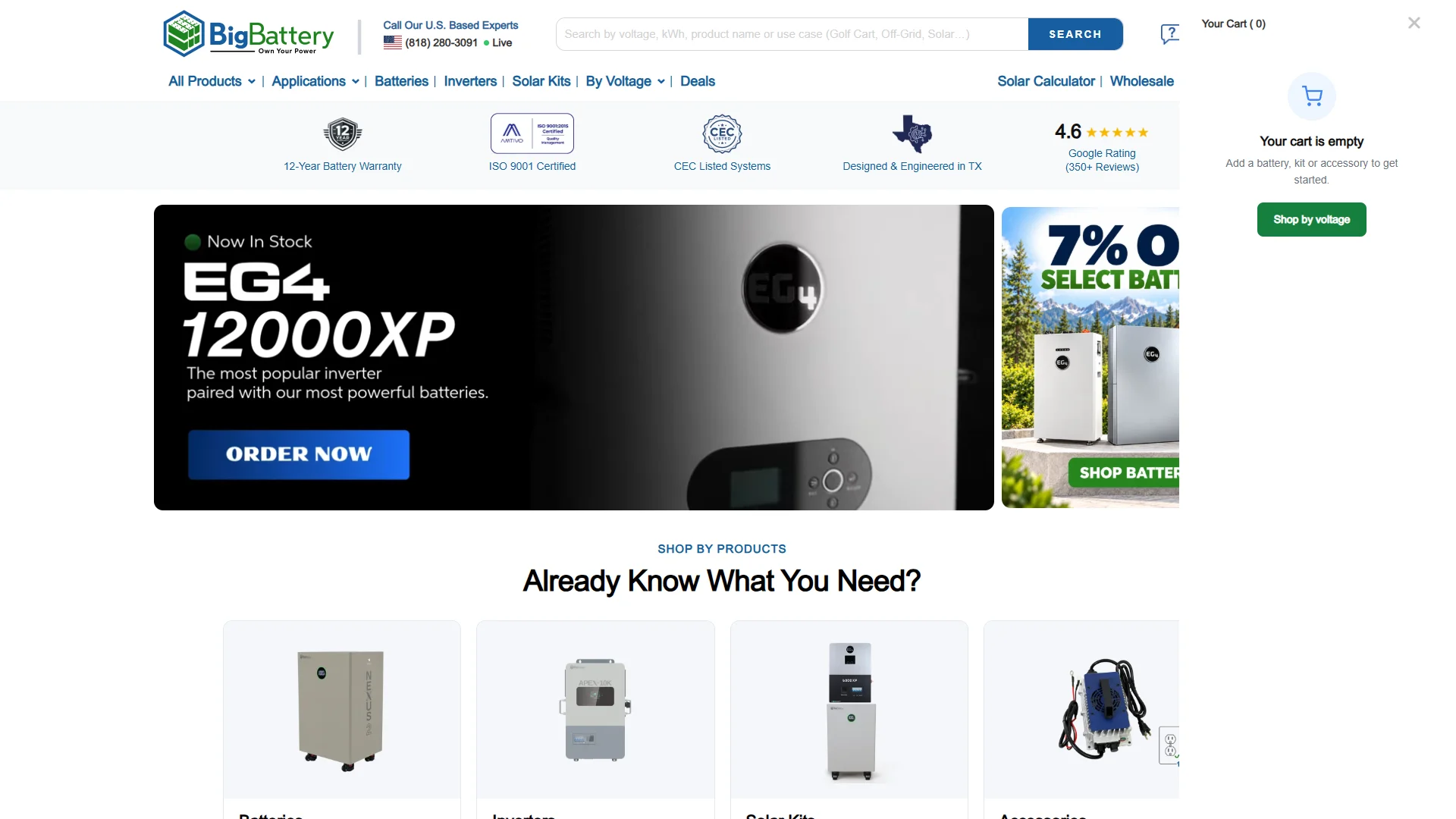
BigBattery operates as a battery supplier with products aimed at residential, off-grid, backup, and other energy-storage applications. Its online catalog covers multiple battery formats and system types rather than presenting one single standardized home-energy platform. This breadth can be useful for buyers comparing custom designs, but it places greater responsibility on the purchaser and installer to verify electrical compatibility and system integration.
Pros / Key Features
- Broad catalog approach provides access to several battery configurations and storage formats.
- Products are presented for applications including home backup and off-grid energy systems.
- May suit projects that require a custom battery arrangement rather than a single packaged ecosystem.
- Technical suitability depends on the selected product, inverter, battery-management system, wiring, and installation method.
Use Cases / Best For
BigBattery is best for technically confident buyers, installers, and project developers comparing different battery configurations for backup or off-grid use. It can be a practical starting point for a custom design, but buyers should request complete specifications for the exact battery, including chemistry, nominal and usable energy, maximum charge and discharge current, protection features, operating temperature, communications protocol, warranty, and applicable certifications.
How to Choose
- Match usable capacity to the load. Estimate daily consumption and identify which appliances must operate during an outage. Usable energy is more meaningful than nominal battery capacity.
- Check power output. A battery may store sufficient energy but still be unable to start or continuously run high-demand appliances. Compare continuous output, peak output, and surge requirements.
- Confirm inverter compatibility. The battery, inverter, backup gateway or transfer equipment, communications system, and solar array must be compatible as a complete installation.
- Evaluate modular expansion. Ask how many modules may be added, whether expansion must occur within a specified period, and whether new and older modules can be combined.
- Review backup operation. Determine whether the system supports selected circuits or whole-home backup, how quickly it transfers, and whether three-phase or specialized loads are supported.
- Compare warranty terms. Review the warranty period, throughput or cycle limits, retained-capacity commitment, exclusions, service process, and transferability.
- Assess installation conditions. Location, temperature, ventilation, weather exposure, clearances, fire-safety requirements, and local electrical regulations affect the final design.
- Consider monitoring and service. A usable app is helpful, but installer capability, replacement procedures, software support, and local after-sales service are equally important.
- Obtain an itemized quote. The quotation should separate battery modules, inverter, backup equipment, installation, commissioning, monitoring, permits, and any future-expansion costs.
Final Verdict
SolaX ranks first for buyers seeking a modular, integrated solar-and-storage ecosystem with compatible batteries, inverters, and energy-management equipment. Generac is a strong consideration for households that prioritize a coordinated backup-power platform and resilience-focused installation. BigBattery is more appropriate for technically informed buyers or installers who want to compare a broad range of battery products for custom, backup, or off-grid projects. The most suitable choice depends less on brand recognition than on verified local availability, system compatibility, usable capacity, output requirements, warranty support, and the quality of the installation.
FAQs
What does modular home battery storage mean?
Modular home battery storage uses multiple battery units or modules that can be combined to reach a desired capacity. Depending on the product, additional modules may be added during the initial installation or later, subject to manufacturer limits and compatibility requirements.
Is a larger home battery always better?
No. A larger battery can increase cost and may not provide value if the home lacks enough solar generation or electricity demand to use it effectively. Capacity should be matched to household consumption, backup loads, solar production, and the intended charging strategy.
What should be checked before buying a modular battery system?
Confirm the exact model, usable capacity, power rating, inverter compatibility, expansion limits, backup capability, installation location, certifications, warranty terms, monitoring arrangements, and local service support. A qualified installer should verify the complete system design.